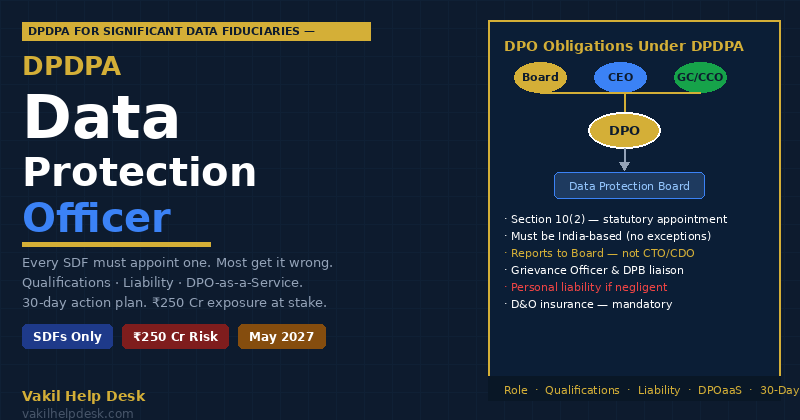
Under the Digital Personal Data Protection Act 2023, every Significant Data Fiduciary in India must appoint a Data Protection Officer. But the DPDPA says almost nothing about who qualifies, what they must do day-to-day, what they can be held liable for, or whether your company even needs one. The Act runs to 44 sections. The DPO gets one. This guide fills every gap — qualifications, reporting lines, daily responsibilities, personal liability, salary benchmarks, the DPO-as-a-Service option for companies that can't hire, and a ready-to-use JD template — everything a Board, a CHRO, or a compliance head needs to get this right before enforcement begins.
- Who must appoint a DPO — SDF criteria and the notification process
- What the DPDPA actually says about the DPO — the full statutory text explained
- DPO qualifications — legal, technical, and experiential requirements
- The complete list of DPO responsibilities (what the DPO does every day)
- Where the DPO must sit in the org chart — independence requirements
- DPO personal liability — when can the DPO be sued or prosecuted?
- Can one person hold DPO + another role? Conflict of interest rules
- DPO-as-a-Service — the outsourced DPO option explained
- Salary benchmarks and compensation by company size (2025 data)
- Ready-to-use DPO Job Description template
- Board reporting — what the DPO must tell the Board every quarter
- The 10 most common DPO appointment mistakes Indian companies make
- DPO appointment checklist — 30-day action plan
1. Who Must Appoint a DPO — SDF Criteria Explained
The DPO appointment obligation does not apply to every Data Fiduciary. It applies specifically to entities that the Central Government notifies as Significant Data Fiduciaries (SDFs) under Section 10 of the DPDPA. If you are an SDF, appointing a DPO is a legal obligation. If you are not yet notified as an SDF, it is still best practice — and likely to become mandatory as enforcement ramps up.
The Central Government may notify any Data Fiduciary or class of Data Fiduciaries as an SDF based on: (a) the volume of personal data processed; (b) sensitivity of the data; (c) risk to the rights of Data Principals; (d) potential impact on sovereignty and integrity of India; (e) risk to electoral democracy; (f) national security; (g) public order; and (h) any other factor the Government considers relevant.
The Government has not yet published a definitive SDF list — this is expected before enforcement begins. However, large technology platforms, financial institutions, healthcare providers, telecom operators, and businesses processing data of more than 10 lakh individuals are most likely to be notified first.
- Large fintech and banking platforms
- Major e-commerce and aggregator apps
- Telecom operators and ISPs
- Health-tech and hospital chains
- Ed-tech platforms with crore+ users
- Social media and content platforms
- Mid-size SaaS companies (1L+ users)
- HR-tech and recruitment platforms
- Insurance aggregators and brokers
- Payment gateways and fintech
- Healthcare diagnostic chains
- Data analytics and AI companies
- Small businesses with under 1L users
- Professional services firms
- Manufacturing companies
- Law firms and consultancies
- Startups in pre-scale stage
- Non-profits and educational institutions
2. What the DPDPA Actually Says About the DPO
Section 10(2) of the DPDPA is the only provision dealing with DPOs. It is worth reading carefully — because what it says, and what it does not say, are both equally important.
"Every Significant Data Fiduciary shall — (a) appoint a Data Protection Officer who shall — (i) be based in India; (ii) be an individual who is able to act as the point of contact for the grievance redressal mechanism under Section 13; and (iii) represent the Significant Data Fiduciary before the Board."
That is the entirety of what the Act says about the DPO. Everything else — qualifications, reporting line, independence, liability, scope — must be inferred from the Act's broader framework, the DPDP Rules, international best practice, and regulatory guidance yet to be issued.
| What the Act Says | What It Means in Practice | What the Act Is Silent On |
|---|---|---|
| Must be based in India | A foreign-based DPO (even for an Indian subsidiary of a global company) is not compliant. Must have physical presence in India. | Whether "based in India" means domicile, working location, or just reachable — awaiting clarification |
| Must be an individual | A company, firm, or agency cannot be the DPO. Must be a named natural person. (DPO-as-a-Service models assign a named individual.) | Whether the DPO must be an employee or can be a contractor/external professional |
| Point of contact for grievances | DPO's contact details must be published. Data Principals file grievances with the DPO first before escalating to the Board. | Response timelines for grievances — likely to be set in Rules or Board guidance |
| Represents the SDF before the Board | In regulatory proceedings, investigations, or enforcement actions, the DPO is the primary contact and representative of the organisation. | Whether the DPO needs legal qualifications to represent the company — or whether a separate lawyer can appear alongside |
3. DPO Qualifications — What Your Candidate Must Actually Know
The DPDPA prescribes no formal qualifications for the DPO. This does not mean qualifications are irrelevant — it means the organisation bears responsibility for appointing someone genuinely capable of doing the job. Appointing an unqualified DPO who fails to prevent a ₹250 crore penalty will be very difficult to explain to a Board.
- IAPP CIPP/A, CIPM, or CIPT certification
- DSCI Certified Privacy Professional (DCPP)
- GDPR DPO certification (international experience)
- Information security certification (CISSP, CISM)
- Prior experience in regulatory investigations
- Sector-specific expertise (fintech, health, ed-tech)
- Experience managing vendor/processor relationships
- Chief Technology Officer — directly controls data systems
- Chief Marketing Officer — commercial interest in data use
- Chief Data Officer — data monetisation conflict
- Head of Product — processes data to build features
- Any revenue-accountable role
- A person based outside India
- A corporate entity, law firm, or agency (as DPO — not advisor)
4. DPO Responsibilities — What the DPO Does Every Day
The DPDPA describes the DPO's role in three lines. The actual job encompasses far more. Here is the complete responsibility matrix — every task a DPO in an Indian SDF must own.
| Responsibility Area | Specific Tasks | Frequency |
|---|---|---|
| Compliance Monitoring | Audit data processing activities against DPDPA obligations; review consent records; test Data Principal rights fulfilment; check retention and deletion schedules | Monthly |
| Board of Data Protection | Primary liaison for all regulatory correspondence; receive and respond to inquiries; facilitate inspections; represent the SDF in proceedings; escalate enforcement actions to Board | As required |
| Grievance Management | Receive and acknowledge grievances within prescribed period; investigate and resolve; escalate unresolved matters to DPB; maintain grievance register; identify systemic issues | Ongoing |
| Data Protection Impact Assessments | Identify processing requiring DPIA; lead or coordinate assessment; document findings; recommend safeguards; obtain management sign-off; track remediation | Per new initiative |
| Breach Response | Lead or coordinate breach detection and assessment; determine notification obligation; ensure DPB notification within 72 hours; oversee communication to affected Data Principals; conduct post-breach review | Per incident |
| Vendor & Processor Management | Review Data Processing Agreements; audit processor compliance; assess cross-border transfer arrangements; monitor subprocessor chains; ensure DPA clauses are enforced | Quarterly |
| Policy & Documentation | Maintain data processing register; update privacy notice when processing changes; review and refresh all consent notices; ensure internal policies align with DPDPA obligations | Ongoing / Annual |
| Training & Awareness | Conduct DPDPA training for all staff who handle personal data; specific training for HR, customer service, marketing, and IT; track completion; refresh annually | Annual + on-hire |
| Board Reporting | Quarterly compliance status report to Board; incident summary; grievance metrics; regulatory interaction update; resource adequacy assessment; strategic recommendations | Quarterly |
5. Where the DPO Must Sit — Independence Is Everything
The DPO's independence is not a formality. An officer who can be silenced, overruled without documentation, or terminated for raising compliance concerns is not a DPO in any meaningful sense. The organisational placement of the DPO determines whether the role works or is merely a compliance checkbox.
- Escalate concerns directly to the Board without CEO approval
- Access any system, department, or dataset relevant to compliance
- Say "no" to a data processing initiative — in writing — without fear
- Speak to external regulators without internal clearance
- Removed for providing unwelcome compliance advice
- Overruled silently — disagreement must be documented
- Given KPIs tied to business growth or data monetisation
- Denied access to systems or processes on grounds of confidentiality
6. DPO Personal Liability — What the DPO Can Actually Be Held Responsible For
This is the section most candidates ask about before accepting a DPO role — and most companies don't think about until it's too late. The DPDPA does not explicitly create personal liability for DPOs in the way that, say, company directors face liability under the Companies Act. But that does not mean DPOs are immune.
7. Can One Person Hold DPO + Another Role? Conflict of Interest Rules
This is the most common cost-cutting question companies ask. Can the General Counsel also be the DPO? Can the CISO be the DPO? Can the CFO? The answer depends on whether the second role creates a conflict of interest with data protection compliance.
| Dual Role Combination | Permissible? | Reason |
|---|---|---|
| DPO + General Counsel / Legal Head | CONDITIONAL | Permissible in smaller organisations where independence is maintained through Board access. In large SDFs, the GC often advises on commercial data strategies — this creates conflict. |
| DPO + Chief Information Security Officer (CISO) | GENERALLY OK | Security and privacy are complementary, not conflicting. A CISO-DPO works well in mid-size organisations. Ensure the CISO has no revenue targets or data monetisation responsibilities. |
| DPO + Chief Compliance Officer | GENERALLY OK | Compliance and privacy are aligned. Workload may be an issue for large SDFs — ensure the CCO-DPO has adequate staff support to fulfil both roles properly. |
| DPO + Chief Technology Officer | NOT PERMITTED | The CTO controls data systems and makes processing decisions. The DPO audits those decisions. These roles are fundamentally incompatible — the DPO cannot audit themselves. |
| DPO + Chief Data Officer / Head of Data | NOT PERMITTED | The CDO's mandate is to leverage data — often the exact opposite of the DPO's mandate. Direct, irreconcilable conflict of interest. |
| DPO + HR Director | NOT PERMITTED | The HR Director processes employee personal data at scale. The DPO audits that processing. Combined role means the same person is supervised and supervisor simultaneously. |
8. DPO-as-a-Service — The Outsourced Option Explained
Not every SDF can justify a full-time, senior DPO hire at ₹50–150 lakh per year. For mid-size SDFs, startups that have been notified, and companies in the pre-SDF stage building compliance foundations, DPO-as-a-Service (DPOaaS) is a legitimate and effective alternative — provided it is structured correctly.
- A qualified individual (not a company) is designated as your DPO
- Their name and contact are published as the official DPO
- They are supported by a team of analysts and legal professionals
- They attend Board meetings and DPB proceedings on your behalf
- Monthly retainer model — typically ₹2–8 lakh per month for SDFs
- Full independence is maintained — they are not operational staff
- Mid-size SDF with 1–10 lakh users
- Company that has just been notified as SDF
- Startup building compliance before scale
- Company that cannot attract a senior enough hire
- Organisation wanting immediate compliance without 3-month hire
- Company with existing compliance team needing senior oversight
- Large SDF with 50L+ users — needs full-time senior DPO
- Company under active DPB investigation
- Business processing children's data at scale
- Organisation with complex cross-border data flows
- Company where data protection is a core competitive risk
- Any situation where the DPO needs daily operational presence
9. DPO Salary Benchmarks — What to Pay in 2025
| Company Type | Experience Required | Base Salary (Annual) | Total CTC |
|---|---|---|---|
| Mid-size SDF (1–10L users) | 3–5 years privacy/compliance | ₹18–30L | ₹22–38L |
| Large SDF (10–50L users) | 5–8 years, DPDPA + GDPR knowledge | ₹35–60L | ₹45–80L |
| Major SDF (50L+ users) | 8–12 years, regulatory experience | ₹75–140L | ₹100–190L |
| Global SDF / MNC India DPO | 10+ years, multi-jurisdiction | ₹150–280L | ₹200–380L |
| DPO-as-a-Service (retainer) | Managed service with named DPO individual | ₹2–8L/month | ₹24–96L/year total |
Rates in Bengaluru, Mumbai, and Delhi-NCR run 10–20% higher than national average. Financial services and healthcare DPOs command a 20–30% premium over general market. Data as of early 2025 — the DPO market in India is nascent and rates are rising quickly.
10. DPO Job Description Template — Ready to Use
The Data Protection Officer (DPO) is a statutory appointee under Section 10(2) of the Digital Personal Data Protection Act, 2023. The DPO is responsible for monitoring compliance with the DPDPA and all applicable data protection obligations, acting as the primary point of contact for Data Principals' grievances, and representing the organisation before the Data Protection Board of India. The DPO operates with full independence from operational business functions and reports directly to [Board Audit Committee / CEO].
- Monitor all personal data processing activities for DPDPA compliance and report findings to the Board quarterly
- Act as the registered point of contact for Data Principal grievances and manage resolution within prescribed timelines
- Represent the organisation in all proceedings before the Data Protection Board of India
- Lead Data Protection Impact Assessments for all new or significantly changed data processing initiatives
- Maintain the organisation's data processing register and ensure it is current and accurate
- Review and approve all Data Processing Agreements with third-party processors and sub-processors
- Lead breach detection, assessment, and notification processes — ensuring 72-hour DPB notification is achieved
- Provide binding compliance opinions on new products, features, and data processing proposals
- Deliver DPDPA training to all staff handling personal data — at hire and annually
- Review and update all privacy notices, consent notices, and data protection policies
- Bachelor's degree in Law, Computer Science, or related field (LLM / Master's preferred)
- Minimum 5 years of experience in data protection, privacy law, or information security compliance
- Comprehensive knowledge of the DPDPA 2023, DPDP Rules 2025, and associated guidance
- Knowledge of GDPR and international data protection frameworks is desirable
- IAPP CIPP, CIPM, or CIPT certification (or equivalent) strongly preferred
- Experience managing regulatory investigations or enforcement proceedings is an advantage
- Must be based in India (statutory requirement under Section 10(2)(a))
- The DPO shall not hold any role that creates a conflict of interest with the data protection function
- The DPO shall have direct access to the Board and senior leadership without requiring intermediary approval
- The DPO shall not be dismissed or penalised for performing duties in good faith
- The organisation shall provide D&O / professional liability insurance coverage for the DPO
- Whistleblower protections apply — reporting genuine violations to the DPB cannot result in adverse employment action
11. Quarterly Board Reporting — What the DPO Must Deliver
The DPO's Board report is not a formality — it is the primary mechanism through which a Board exercises oversight of data protection risk. A well-structured quarterly report protects the Board, the DPO, and the organisation. Here is the template.
| Report Section | What to Include | Time Taken |
|---|---|---|
| Compliance Posture | RAG status across 8 compliance domains: Consent, Notices, Rights Fulfilment, Security, Vendors, Breach Response, Grievances, Cross-Border. Key gaps and remediation timeline. | 5 min |
| Incidents & Breaches | Number of data incidents in the quarter; severity classification; Data Principals affected; DPB notifications made; root cause and remediation actions. | 5 min |
| Grievances | Grievances received; category breakdown (access, erasure, correction, etc.); resolution time; escalations to DPB; systemic issues identified. | 3 min |
| Regulatory Interactions | Any communications from the Data Protection Board; inquiries received; responses submitted; ongoing proceedings; directions received and compliance status. | 5 min |
| Vendor Compliance | DPAs in place vs. outstanding; processor audits conducted; significant non-conformance findings; cross-border transfer status. | 3 min |
| Emerging Risks | Regulatory changes (new Rules, DPB guidance); industry incidents affecting peers; new processing activities proposed; AI or new technology deployment risks. | 5 min |
| Resource Adequacy | Is the DPO function adequately staffed, budgeted, and empowered? Any access restrictions or interference with independence? Budget requests for next quarter. | 3 min |
| Board Decisions Required | Any matters requiring Board approval or resolution — budget approvals, policy sign-offs, strategic compliance decisions, investigation authorisations. | 5 min |
12. The 10 Most Common DPO Appointment Mistakes Indian Companies Make
13. DPO Appointment Checklist — 30-Day Action Plan
Appoint a Qualified, Independent DPO — Before the Data Protection Board Comes Looking
The DPO is the most consequential hire — or appointment — a Significant Data Fiduciary will make under the DPDPA. Get it wrong and you have a checkbox, not a compliance function. Get it right and you have an organisational safeguard that protects your Board, your users, and your business from ₹250 crore in exposure.
Vakil Help Desk provides DPO-as-a-Service for Indian Significant Data Fiduciaries — a named, qualified, India-based individual as your DPO, backed by a team of data protection attorneys and compliance specialists. We also advise on internal DPO appointments: structuring the role, drafting the contract, running the Board presentation, and building the compliance programme from day one.
Not sure whether you need a DPO yet? We offer a free 30-minute SDF assessment call — we will tell you honestly whether you are likely to be notified, and what you should be building now regardless.